Skip the Awkward Icebreakers and Do Some Math Instead
The first few days of high school math are a little strange.
You want students to get comfortable in your classroom. You want to learn something about them. You need to introduce procedures and expectations. And somewhere in there, you’d also really like to figure out what math they remember from last year.
But your students have probably already shared an “interesting fact” about themselves, played Two Truths and a Lie three times before they reach your classroom.
So instead of planning another traditional icebreaker, try using the first few days to help students get comfortable doing math in your classroom.
The best first week of high school math activities don’t have to feel like a test OR even like a typical review worksheet. You can get students talking, thinking, noticing, creating, and reviewing prerequisite skills while you quietly learn a LOT about the mathematicians sitting in front of you.
Here are a few free ideas you can try, plus some ready-to-go options for Algebra 1, Geometry, and Algebra 2 when “make it myself” is definitely not on your back-to-school to-do list. (because, honestly, who has time for that?!)
What Should You Actually Do During the First Week in a High School Math Class?
There’s a tricky balance during those first few days. Plus, it doesn’t help when we are ALREADY behind on content when we walk in the door on day one!
If you go the pre-assessment route, you may get more information about their first-day nerves than their actual math ability.
If you spend three days on games that have nothing to do with math, then you’ve lost valuable time to start establishing what learning will look and feel like in your classroom.
Instead, I like to look for activities that accomplish more than one goal.
My favorite first-week activities help students:
- Review prerequisite skills without the pressure of a test.
- Get comfortable talking about math with classmates.
- See that math exists outside their textbook.
- Give you a glimpse of what they remember.
- Learn how activities and discussions will work in your classroom.
- Have a little FUN before settling into the regular routine.
Here are some ways to make that happen.
1. Start With a “Where Do You See Math?” Challenge
Before reviewing a single equation, challenge students to find math around them.
Put a simple question on the board:
Where have you seen or used math outside of math class?
Give students a few minutes to brainstorm individually or with a partner. Encourage them to think beyond obvious answers like “at the store.”
They might come up with sports statistics, video game coordinates, recipes, music, architecture, driving, fashion design, social media analytics, construction, art, or dozens of other examples.
You could even turn this into a classroom challenge. Give pairs two minutes to list as many examples as possible, then compare lists.
Why It Works
This is low stakes, everyone can participate, and you immediately establish that your math class is about more than completing problems on a page.
Teacher tip: Save some of their examples! Bring them back up throughout the semester when you encounter related concepts.
2. Try a Math “Would You Rather?”—Then Make Them Defend It
Give your typical This-or-That game a math-class upgrade.
Ask students questions such as:
- Would you rather calculate a discount or a tip?
- Would you rather solve 10 equations or graph 5 lines?
- Would you rather work with fractions or decimals?
- Would you rather have a calculator but no notes or notes but no calculator?
- Would you rather explain your answer out loud or write an explanation?
Have students move to one side of the room, hold up A/B cards, or vote digitally.
Then comes the important part:
Ask why.
You’re getting students accustomed to making a choice, explaining their reasoning, and hearing different perspectives, all without calling it mathematical discourse on Day 1. Starting mathematical conversations when there’s no pressure of right/wrong answers shows students it’s okay to take risks in your classroom!
Want to Sneak Some Skills Review Into It?
You can take the same concept one step further by combining getting-to-know-you questions with actual prerequisite skills review.
My Back-to-School Get-to-Know-You Skills Review digital activities are designed to help students share their preferences while reviewing math they’ll need for their new course.
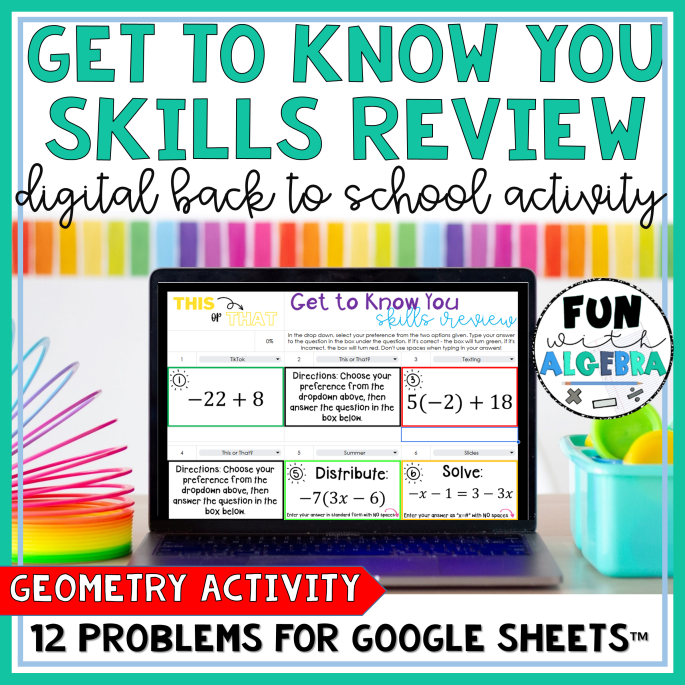
- Algebra 1 Back-to-School Get-to-Know-You Skills Review
- Geometry Back-to-School Get-to-Know-You Skills Review
- Algebra 2 Back-to-School Get-to-Know-You Skills Review
It’s a way to learn a little about your students while also getting a peek at what they remember…without starting the year with a formal assessment.
3. Put Math in the Wild on Trial
Show students an example of math being used in the real world and ask them to investigate it.
You might show:
- A sale sign advertising a percentage discount
- A graph from a news article
- Sports statistics
- A floor plan
- A recipe that needs to be doubled
- A misleading graph
- A phone plan or subscription price
- A social media poll with percentages
Ask:
What’s the math here?
Then let students notice before you start teaching.
There’s no need for a perfectly structured lesson. The goal is simply to get students looking for quantities, patterns, relationships, shapes, rates, percentages, and other mathematical ideas.
Bonus: Ask students to find their own “math in the wild” example for homework or extra credit and bring it back to class.
4. Use Math Trivia to Get Students Curious
Sometimes you don’t need students to prove what they know yet. You just want them curious.
Math trivia can be a fun way to kick off the year because students can make guesses, learn surprising facts, and start noticing that math shows up in places they may never have considered.
This is especially helpful if you teach multiple preps because the activity doesn’t have to be tied to one specific course.
My Back-to-School Secondary Math Trivia Activity uses self-checking digital task cards, so it can work with students across your secondary math classes.
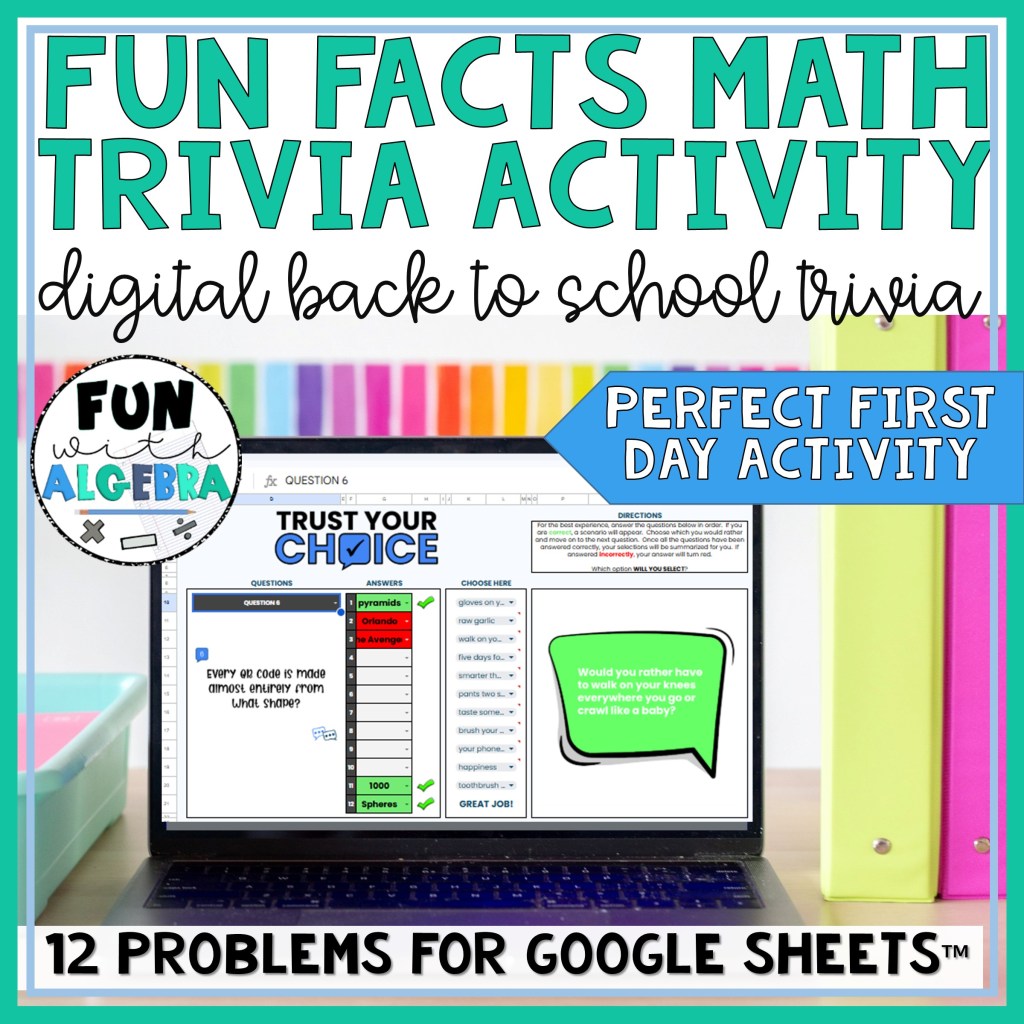
Use it as a first-day activity, early-finisher option, partner activity, or a break between procedures and syllabus information.
And unlike asking students to tell 28 strangers something interesting about themselves, the attention stays safely on the math.
5. Let Students Create a “Math About Me” Without the Cringe
“Math About Me” doesn’t have to mean filling a worksheet with your age, shoe size, and number of siblings.
For high school students, try making it more open-ended.
Challenge students to create four numbers or mathematical expressions that represent something about them.
For example, a student might use numbers connected to:
- A jersey number
- The number of hours they spend at practice each week
- Their favorite athlete’s stats
- A meaningful date
- How many books they read last year
- The number of pets they have
- The distance they’ve traveled
- A favorite game’s score or statistic
Students can reveal as much (or as little) personal information as they want.
Have a partner try to guess what each number represents before students explain their choices.
Now students are getting to know each other, but math gives the conversation somewhere to go.
6. Review Prerequisite Skills Without Calling It a Pre-Test
Eventually, we DO need to know what they remember from last year. How hard did the summer slide hit??
But that doesn’t mean the first interaction students have with math this year needs to be a page titled PRE-ASSESSMENT. Try turning review into an activity instead.
You can choose several prerequisite skills and put one problem at each station around the room. Students rotate in pairs, solve the problem, and leave a quick confidence rating:
Got it | Need a refresher | What is happening?
You get useful information about where students are starting, while students get a low-pressure preview of what’s coming.
Make the Review More Fun
If you’d rather have something ready to go, this is where a review activity can do double duty.
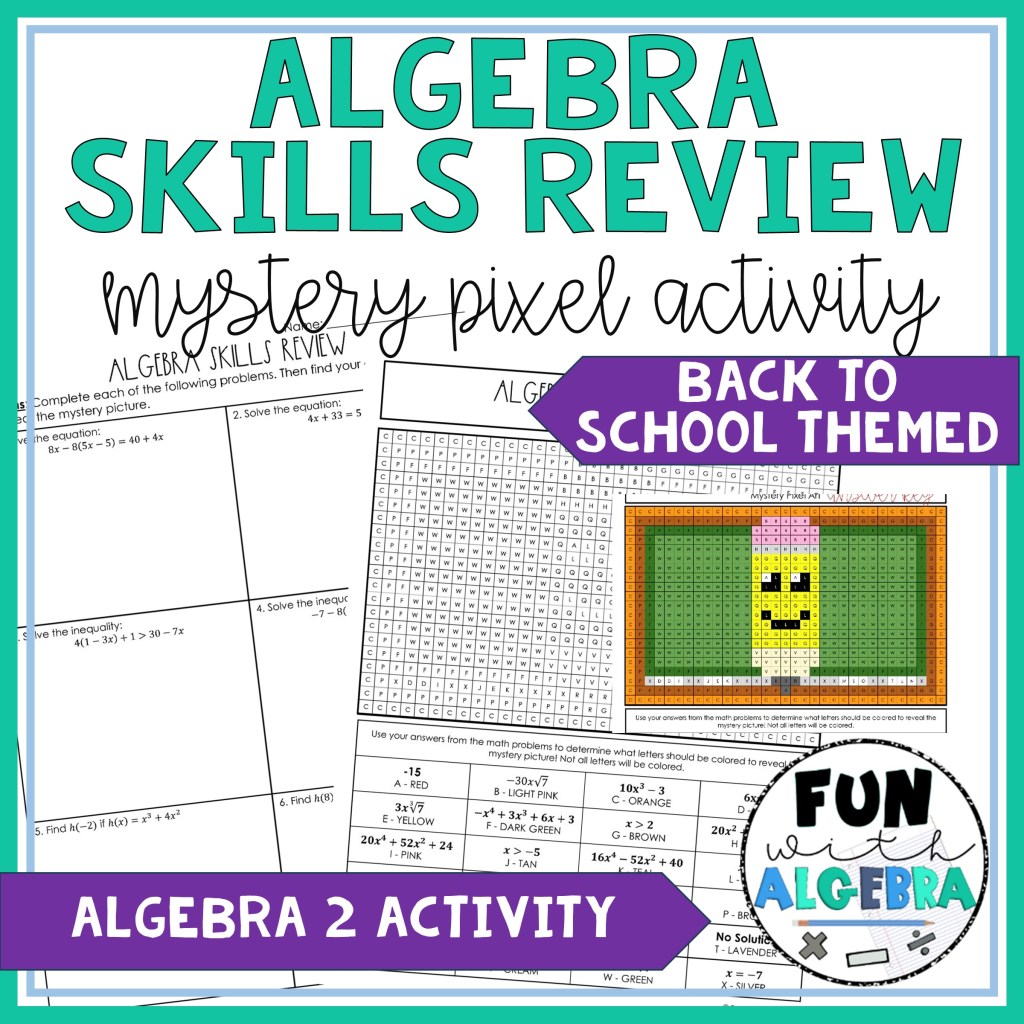
For Algebra 1, I have a Back-to-School Skills Review Color-by-Number Math Activity.
For Geometry and Algebra 2, I have Back-to-School Skills Review Pixel Activities.
Students get to review prerequisite skills in a format that feels different from a traditional worksheet, while you get an early look at skills that might need a little attention.
- Algebra 1 Back-to-School Skills Review Color by Number
- Algebra 2 Back-to-School Skills Review Color by Number
- Geometry Back-to-School Skills Review Printable Pixel Activity
- Algebra 2 Back-to-School Skills Review Printable Pixel Activity
7. Introduce Students to Real Mathematicians aka THEMSELVES!
Here’s one more way to set the tone for your classroom: show students from the beginning that mathematicians aren’t just people in old textbook photographs. Show them EVERYONE is a math person!
I love this because it doubles as classroom decor! Students can answer the questions on the hexagon about themselves, then decorate or color the hexagon however you want! Copy on colored paper or white paper to offer more space for students to get creative. Then, hang them up in your room for everyone to see the mathematicians who are hard at work in your room!
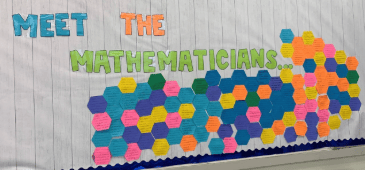
And I’ve got a free resource to make this one easy.
Grab my FREE Meet the Mathematicians Bulletin Board here.
Your First Week Doesn’t Have to Be All Syllabi and Icebreakers
The first week of high school math doesn’t need to be packed with formal assessments or even activities that have nothing to do with math. Instead, use those first few days to show students what they can expect from your classroom. We’re going to notice math. We’re going to talk about math. We’re going to review things we’ve forgotten. We’re going to make mistakes. And yes, we’re allowed to have some fun while we’re doing it.
Choose one or two of these first week of high school math activities, keep the pressure low, and use what you observe to help decide where your students need to go next.
Want your back-to-school math review already planned?
Check out my back-to-school activities for Algebra 1, Geometry, and Algebra 2 to find ready-to-use review activities for your classes.
Check out all my DONE FOR YOU activities here on TPT!
And don’t forget to grab the FREE Meet the Mathematicians Bulletin Board before you go!
Grab the bulletin board set HERE!
Have an awesome idea that you do your first week in school? I’d love to hear about it! Drop a comment or email me: contact@funwithalgebra.com!

