
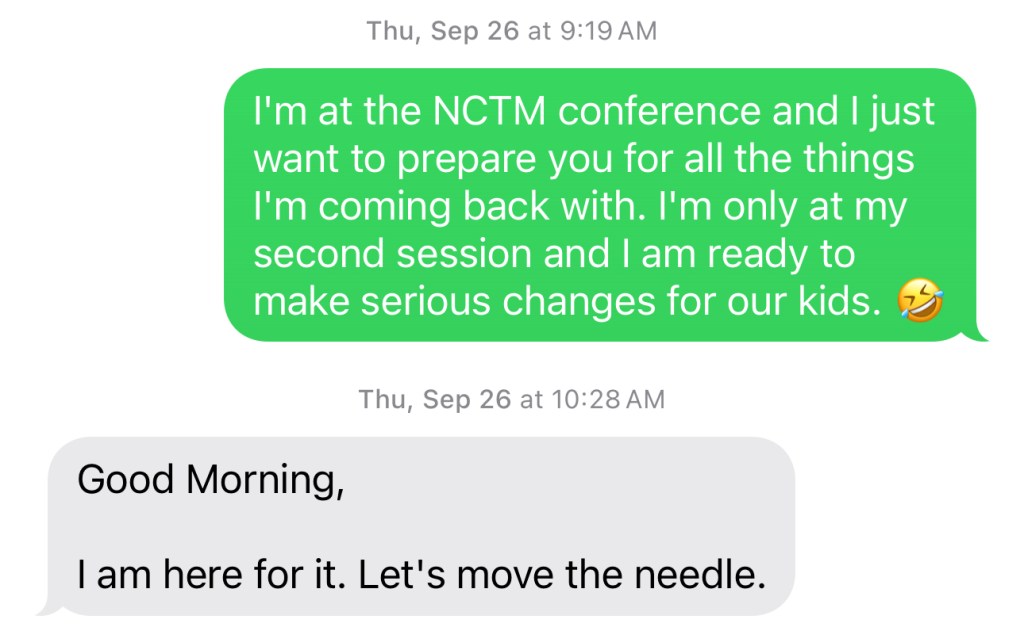
A couple weeks ago I went to the NCTM conference in Chicago and my mind was BLOWN by the awesome ideas I heard. I even texted my administrator the very first session I was in to prepare him for all the things I was coming back with! (ignore the fact that I just got right down to the point of me ready to shake things up with no greeting because I was so excited and he responds with “good morning”)
Anyways, here are three activities that I learned about (or were reminded of) at the conference and have implemented in my classroom already in the past 2 weeks!
1. “Heads up”
Many students are familiar with the game Heads Up, since it has been a popular game on their phones for awhile, so this was the game I decided to start with! I gave them directions first and then we did a practice word together as a class, then a few practice rounds. The practice rounds were random words (not math related) so that I could get them practicing talking to each other and getting the hang of it before making it content related. I gave them 2 minutes each round and then switched each round between which partner was the guesser and which was the describer. After 2 rounds, I did half random words and half math words and then after 2 rounds of half/half, I did 2 rounds of full math vocabulary. I numbered the words so that as I was walking around if someone was stuck, they could tell me the number they were on and I could help with the clues instead of them trying to tell me where they were. I gave them a list of 10 words at a time as well, so that they could start with the ones they knew and then go back to the challenging ones. After each round we spent a few minutes sharing our clues and discussing where people got stuck which promoted great discussions throughout my classes!
Want a copy of the slides I used? Make sure you’re signed into a google account and CLICK HERE to make a copy! (You’ll notice the last two rounds are *almost* the exact same, except for one word and the last round I put them in reverse order – some kids did notice, but not many!)
2. Math Journaling
At first when I heard math journals, I was like “omg I have no time for that” or “NOPE writing takes too long” but then the person gave actionable steps and prompts that were FANTASTIC. This has been a great way for my students to explain their thought processes and reasoning in writing. At the end of each lesson, ask students to reflect on the key concepts they learned and to explain how they solved specific problems using proper math terminology. You can pose prompts like:
- “Explain the steps you took to solve the equation using the words ‘distribute’ and ‘inverse operations.'”
- “Describe how you would teach someone to calculate the area of a triangle, and include key terms like ‘base,’ ‘height,’ and ‘formula.'”
Math journaling promotes both literacy and critical thinking, as students must articulate their ideas clearly and use precise language. It also serves as an opportunity for them to self-assess and reflect on their learning. Journals can become an excellent conversation starter during class discussions, as students can share and compare different ways they approached the same problem. This year I abandoned Interactive Notebooks for my algebra 1 classes, but still use them in geometry & algebra 2 so they journal in their notebooks. But my Algebra 1 classes journal on a google doc they’ve shared with me OR I have them do an exit ticket where they have to write. I’m tired of them cheating their way through the exit tickets or copying down answers from someone else. With writing, I can see clearly who understands what is going on and who is lost. Plus, it gives them an option to practice what they know in another form than just “math writing” which is a huge goal for our school this year!
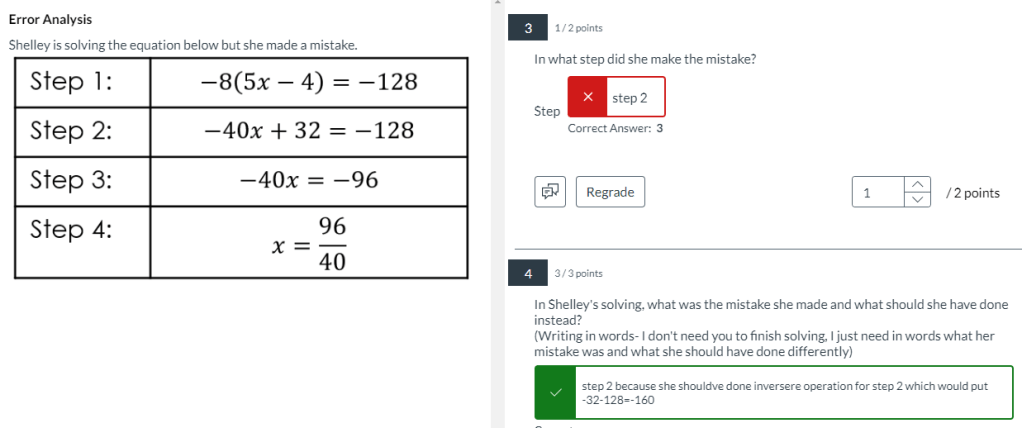
Another option for math journaling or writing is error analysis. Students have to identify the error and explain what the person should have done instead. This gave students time to practice using the math words they have learned to explain problems in written form. See an example of error analysis from an exit ticket below:
3. Team Tests/Quizzes
FULL DISCLAIMER: I have only tried this with my Honors Algebra 2 class (9th graders – so double accelerated) so I am fully aware that this may not work well in lower level classes, but I do have it in my plans to try it with my Algebra 1 students this unit!
For the team quiz, I gave them rules on the board. They had the option to work by themselves (as I have a few who opt to do that) or with a group of no more than 3. I told them that each person had to carry their own weight and that they could kick people out of their group if that person was not pulling their weight. Then I told them “the catch” to working in groups:
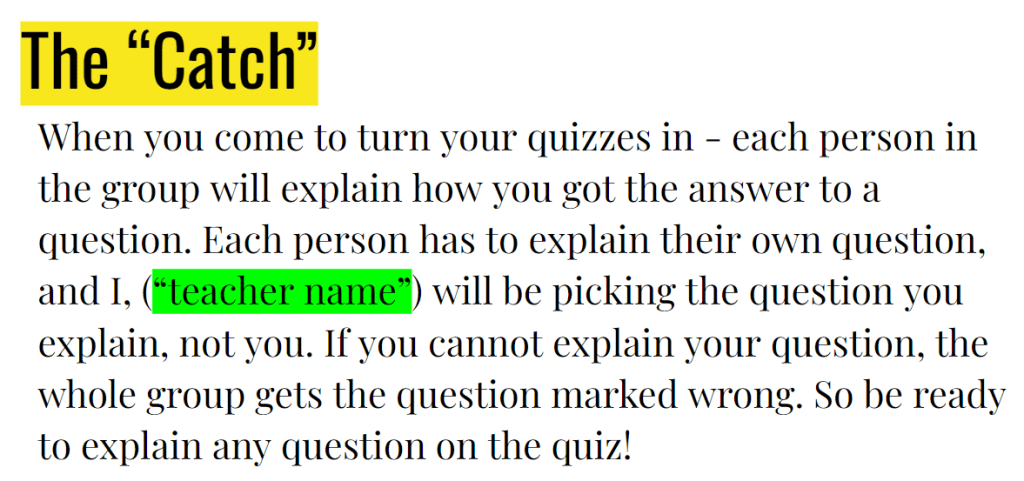
Each person had to explain a question of *MY* choice to me so that I know that they understood how they got the answer. And if they couldn’t explain how they got the answer, then the whole group got that question marked wrong (I only graded one of their papers – they got to choose whose paper I graded at the end). Now, this created the BEST math conversations in my classroom I have heard in a long time. As they were solving each problem, they were yelling (forcefully telling) the weaker students, “no but do you really understand this because if she picks this problem for you, and you can’t explain it then we get it wrong and I’m going to be so mad at you” This was the best quiz grades I’ve seen in that class as well, and I feel that their test that they take tomorrow will be amazing because they learned so much from being taught from their peers but also teaching their peers each step of solving absolute value equations & inequalities! I ended up doing a random number generator to help me pick the problem each person explained to me, to make it easier on me plus it was totally random and “the computer’s fault” if they got one of the word problems to explain!
Want a copy of the rules I used? Make sure you’re signed into a google account and CLICK HERE for the copy of the rules. Make sure to change the green highlighted “teacher name” to your name before sharing with students!
I’m a firm believer that as students become more comfortable with math vocabulary, their ability to solve problems and explain their thinking will grow, leading to greater success and engagement in the math classroom and beyond!
Do you have any tips or tricks on how you bring literacy into your math classroom? Drop them in a comment below or send me an email: contact@funwithalgebra.com! I’d love to here from you!
 Fun With Algebra